Showing posts with label chaos space marines. Show all posts

Thursday, 30 January 2014

Warhammer Scenery - Realm of Battle Board

As any hardened war gamer will know, when you first start out with this hobby you're happy to just roll out a mat to play on, and use empty tissue boxes as hills to make it interesting. Then, as you get deeper into it, investing a lot of time and effort and money into your army, spending hours and hours painting your models to get them just right, you realise you ought to be investing a little bit more time in your terrain.

Such was the case in our house. The only real investment we made in our gaming board in the early days was a 6' x 4' sheet of MDF (cut neatly into two halves for ease of storage) and the old Games Workshop battlemat. Not long after, we bought a couple of the hills and some trees. That lasted us for a good few years, but once we'd switched our focus from Warhammer Fantasy Battle across to Warhammer 40k, we decided the lush green battlefield we had didn't really cut it for the gritty battlefields of the 41st millenium!

It was about the same sort of time that Games Workshop brought out the Realm of Battle board, so after much debate, we eventually invested in one. It was left unpainted for quite a while, as we couldn't decide how to do it. Plus, a lot of our models were unpainted as well, so it didn't seem out of place to be playing on an unpainted board. More recently, however, we've found ourselves able to field almost full armies of painted models, and the unpainted scenery was starting to jar a little. So back in October we decided to start painting it.

We spent ages online looking at the various different ways people had painted theirs. We eventually decided on a brown colour scheme, a sort of desert(ish) wasteland theme. We did the base layers, but then it sat half painted for a couple of months while we figured out how to finish it off. A couple of weeks ago, we sat down in front of the telly and got out the paints again, and after several hours of endless drybrushing, it is now almost complete.


It makes such a difference having it properly painted. It's not quite finished, as we still need to varnish it and finish off the skull pits with water effects. So it's currently living on the dining room table, as we can't put it away until we've protected the paint job.


It was a bit of trial and error to get the colour scheme to work, but here's a run down of how we did it in the end.

1. We basecoated the entire board with black paint (we used a spray can of black we bought in Wickes, as it was slightly cheaper than the Games Workshop Chaos Black spray), and then sprayed the whole thing brown, leaving the exposed rock edges black. The brown spray we used was from Halfords, their own brand Camouflage Spray Paint in Brown - ultra matt. Lovely coverage - we used about one and a half cans for the whole board.

2. The rock sections were all painted with Adeptus Battlegrey from the Citadel foundation paint set.

3. Rock sections drybrushed with Astronomicon Grey from the Citadel foundation paint set.

4. The brown areas of the board were drybrushed with yellow acrylic paint. Rather than use up the expensive-in-large-quantities Citadel paints, we bought a tube of Galeria acrylic paint from Hobbycraft in the colour Yellow Ochre. Using 1" flat brushes, we managed to do all six panels in less than the running time of Man of Steel. The skulls in the pits were heavily drybrushed with Bleached Bone Citadel paint, then two layers of Thraka Green Citadel wash was applied. We still need to go back over them and drybrush the very top edges with Bleached Bone, before filling the pits with Woodland Scenics Realistic Water.

5. The skulls and bones found in piles around the rocks on the board were painted with Bleached Bone, and then washed with Agrax Earthshade Citadel wash.

The craters (set from Games Workshop) were painted to match the battleboard. Undercoated in black, sprayed with the same brown spray and then heavily drybrushed with the yellow ochre. To define them a little more, we chose prominent sections of the crater edges and drybrushed them as rocks, using the same combination of grey paints as above. We then went over them with Scorched Brown Citadel paint, drybrushing inside the craters to darken down the interior of the crater.


To properly see how it looked, we set up a mock battle on the board using only fully painted models. It's a bit one sided, as we have painted far more Chaos Space Marines than we have Imperial Fists!


I still have a fair few bits of scenery work to do; I've got some homemade pieces that haven't been painted yet, and I need to sort out the bases for my Imperial Fists and that second Heldrake. The buildings already on the board in the shot above are not quite finished either, lots of little frustrating details to do, but I will share progress on those so far in another post.

Thursday, 27 June 2013

Warhammer Scenery - Heldrake Base

Back in October last year, I took some time out of my knitting/crocheting schedule to help Jamie out with his Chaos Space Marine army. See, the deal we have is he paints the models, but I do the bases. I did a few funky rocky bases, but was then struck with the inspiration to make some proper scenery.

Serious crafting requires artistic vision

I started small, just some interesting embellishment for the flying base of his heldrake model and a simple rocky outcrop to use as terrain during a game. The building part didn't take very long, but I lost interest when I was stuck with the endless painting.

Now we have an airbrush, the painting part is a lot easier, so I've pulled it all back out and set to with a will! First to finish, the heldrake base.


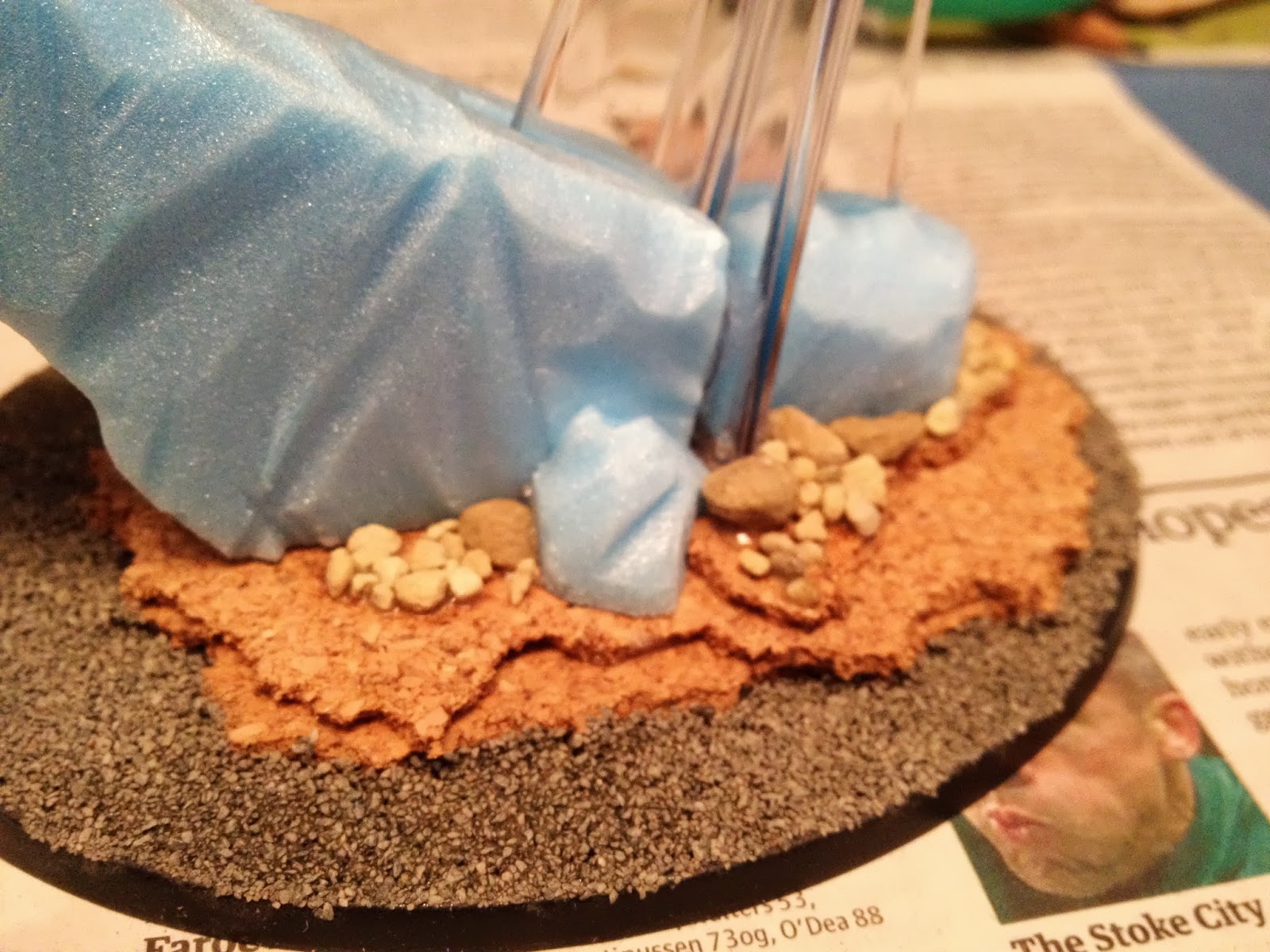
After placing the flying stem and gluing it down, I used cork sheeting and a hot glue gun to add some height to the flat base.


I filled the rest of the base with plain old boring basing material (I think this one is labelled as "lava").


Next up was the fun part. The rocky spur was made from polystyrene sheeting, cut and carved to fit with a hot wire cutter. I love my hot wire cutter, it's so much fun! I had to cut two separate chunks to get it to fit around the stem.


Carving it to look like rock is a real skill!


The ground around the spire was decorated with smaller stones and some carved boulders.


The stem was then masked with tape to protect it from paint. All of the rock parts were painted with textured masonry paint (a couple of coats) and then the whole model was undercoated with black spray. At this point I got fed up of the painting aspect (it takes ages to dry!) and the base remained in this state until last week.


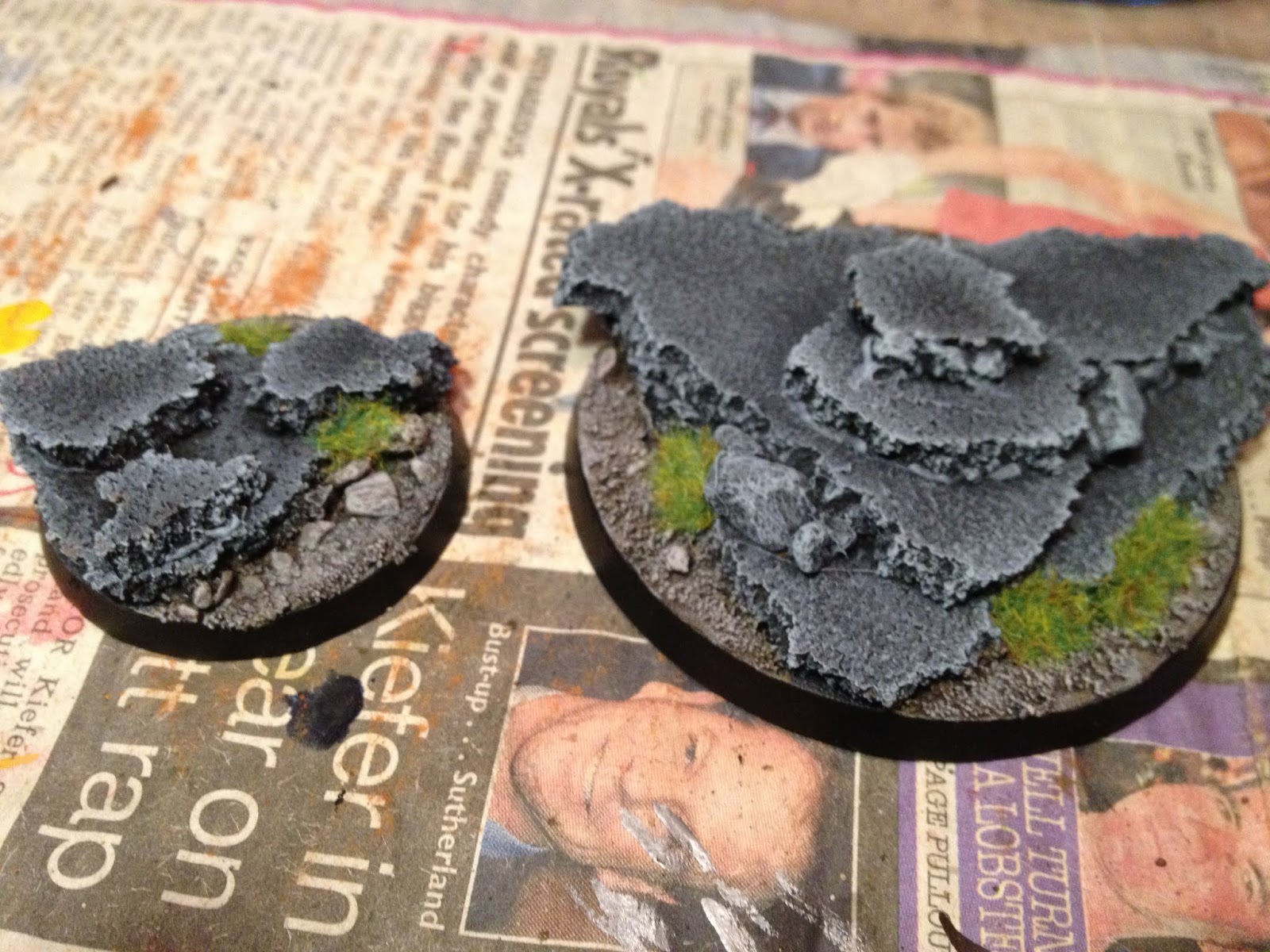
After just half an hour with the airbrush (most of which time is spent cleaning the damn thing between colours, and hunting for the right bottle of paint) the rocks were done! All over spray with a dark grey, then an almost all over spray with a lighter grey, finally targeted highlights with a light grey.

The sand was sprayed dark brown, then highlighted up with two lighter shades of brown. I wanted the model to fit the colour scheme of the other bases I'd painted last year, sandy bases with grey rocky outcrops.


The finishing touches were the greenery. Some twigs robbed from the back garden, pushed into the polystyrene behind the stem become trees, with clump foliage (from the model railway section of the model shop) glued on with Copydex (which smells of fish, by the way, it's horrible stuff). Some additional clump foliage around the base of the tree and to hide the hole where I miscut the rocky spire to fit the stem, and some static grass on the sand to cover the gaps.


I really love the effect of the tree. I'm also really pleased at how closely my finished base resembles my initial visualisation!


Jamie has since bought a second heldrake, so I will be putting my thinking cap on again to create a second base that matches but is different.

In the meantime, I'm going to finish painting the rocky spires terrain piece, and a gothic ruin piece I started at the same time as these. With the ease of painting provided by the airbrush, I can see myself making a lot more scenery over the next few months!

Tuesday, 23 October 2012

Warhammer Scenery - Rocky Bases

I've not really done much crafting outside of knitting and crocheting for some time now. Not really living up to my self proclaimed title of Master of a Thousand Things! But this past week or two, I've been focusing on a different sort of crafting - making bases and scenery for Jamie's Warhammer 40k models and games. I've been sharing pics of my progress on Instagram (you can find me there as supertinks), but thought I'd share the work here too, as I am quite proud of what I've achieved!

I started out with something simple - bases. Jamie's been on a real drive to finish off his Chaos Space Marine army, but none of the models bases had been painted. This is because Jamie lets me do that, and I hadn't been in the mood for some time. With the army nearing completion, I thought I'd better get started.

Chaos Lord
Taking inspiration from the Chaos Lord model, who comes with a moulded rocky base, we decided to go for a simple rock and sand look, using static grass to artistic effect on each finished base. Having recently got my hands on some proper basing materials, we decided to make suitably impressive bases for the other character models and large models in the army.

Typhus (image from Games Workshop)

Jamie bought the above Typhus model recently, and I thought I'd start with that. The model is an old sculpt, so it's not particularly dynamic. It comes with a plain base, so I took some thin cork sheeting and made him a little rocky platform.


I had to be careful to keep both sides of the platform level, as he's designed to sit flat on the base.


I just tore the cork sheeting into appropriate sizes, and glued it down with a hot glue gun. The stones were added afterwards, using the hot glue gun for the larger ones, and PVA glue for the sand.

Spurred on by the relative ease of building that base, I got out the Helbrute model from the Dark Vengeance box set.

Image from Games Workshop

Another model designed to sit flat on a plain base, although this one is more dynamically posed and has a stone underneath one foot. Whatever I did had to incorporate that stone.


I used the same principles, tearing up cork sheet to build my rock, before adorning the gaps with stones of varying size and gluing sand to the remaining exposed base. The cork was shaped to fit the large feet of the model.

Painting the bases was easy. I just used the same colours I used on the pre-made base above. They were undercoated with the Games Workshop Chaos Black spray, then a heavy drybrush of Adeptus Battlegrey from the Citadel foundation paint range.


After that dried, I highlighted the rock with a drybrush of Astronomican Grey (also from the foundation paint range).


Once that was dry, I turned my attention to the sand. This is the most ridiculous part of painting Games Workshop bases, as you stick perfectly reasonable sand onto the base, then paint it to look more like sand. If you don't paint it, it doesn't look real compared to the rest of the model!

The sand is first painted with Khemri Brown (foundation paint).


Then, a wash of Devlan Mud (from the Citadel Wash range).


Once the wash was completely dry, I drybrushed the sand with Dheneb Stone (another foundation paint). When I was done drybrushing, I took some Chaos Black (from the Citadel paint range) and painted the edge of the base.


The final touch is to glue on some static grass in strategic places. I use the grass to hide particularly poor areas of the base, so gaps in the sand material on the base itself, or embarrassing looking areas of the cork, for example where there is a splodge of glue showing.


And here are the finished bases with their (still unpainted) models balanced on top:


I am particularly pleased with the way the helbrute sits on his base. Once Jamie has painted the model, and the rock under his left foot has been painted to match the base, it will look seamless.

In order to attach the models to the base when they are done, we will drill into their feet and insert metal pins, which will push easily into the cork and provide a more stable attachment than simply gluing them down.

Following the success of these bases, I have turned my attention to more exciting bases, such as the bases for the flying models, and building proper battlefield scenery pieces. These are still works in progress, but I will be back with step by step guides to how I put those together once they are done!
Related Posts Plugin for WordPress, Blogger...